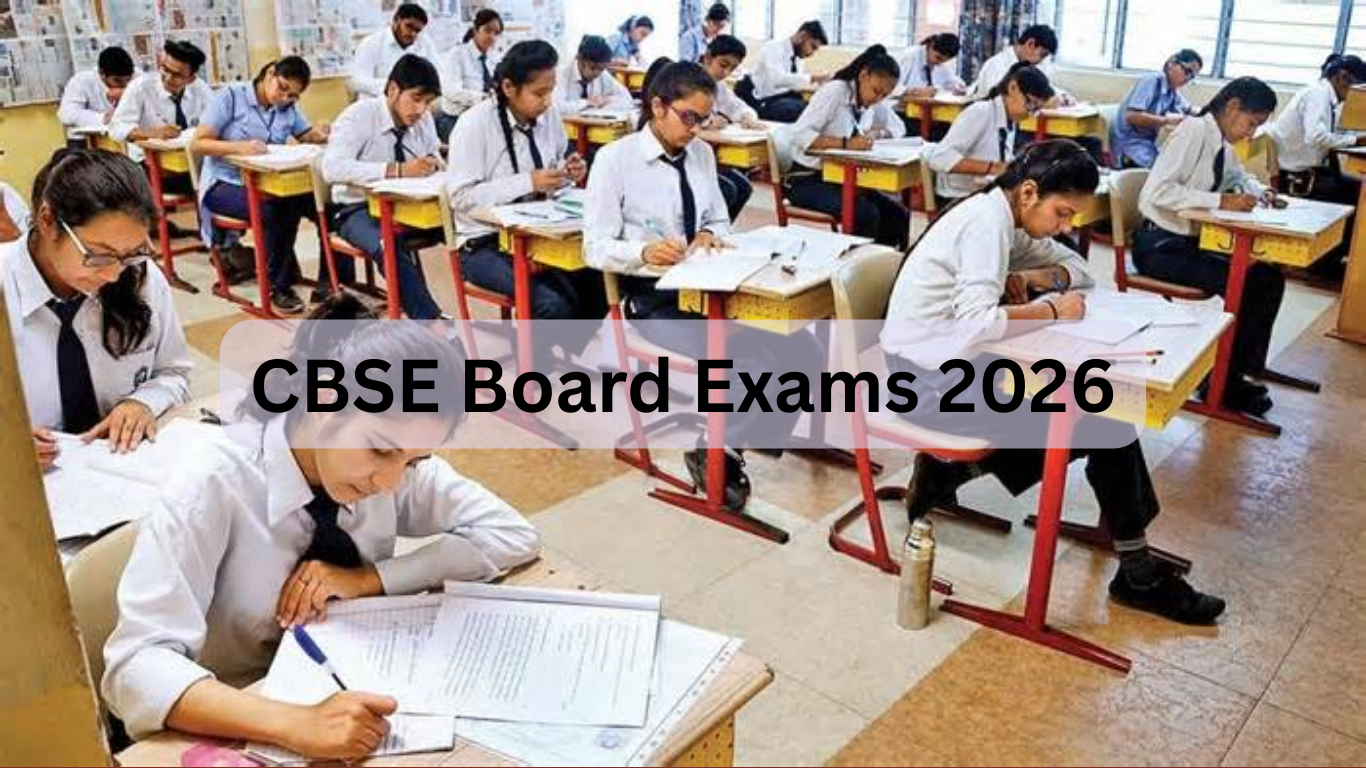
CBSE Class 12 Board Exams 2026: In a significant change aimed at accelerating evaluation and enhancing transparency, the Central Board of Secondary Education (CBSE) has opted to implement On-Screen Marking (OSM) for the assessment of Class 12 answer sheets, commencing with the 2026 board examinations. This initiative is part of the Board’s larger strategy to adopt digital processes and improve efficiency in examination-related tasks. However, it has been clarified by CBSE that Class 10 answer sheets will still be assessed in the traditional physical format in 2026.
CBSE administers Class 10 and Class 12 board examinations annually across India and in 26 other countries, serving nearly 46 lakh students, which makes the evaluation a large-scale and time-consuming endeavor.
What CBSE Announced
In announcing this decision, Dr. Sanyam Bhardwaj, the Controller of Examinations at CBSE, stated that the Board is implementing On-Screen Marking as part of its ongoing efforts to improve efficiency and transparency in the evaluation process. As per the official communication dated February 9, 2026, this initiative is anticipated to significantly streamline the evaluation process while decreasing reliance on manual methods.
Reasons for CBSE’s Transition to On-Screen Marking
CBSE has outlined several reasons for the transition to digital evaluation for Class 12 answer sheets:
- Accelerated evaluation through increased participation of teachers from affiliated schools
- Removal of totalling errors, as marks will be calculated automatically
- Automated coordination, minimizing manual intervention and the potential for errors
- Elimination of the need for post-result verification of marks, thereby reducing delays after results are announced
- Decreased manpower requirements for verification-related tasks
- Savings in transportation time and costs, as physical answer sheets will not need to be transported
- Teachers can remain at their own schools and continue their regular responsibilities while evaluating
- An opportunity for all affiliated schools to take part in the evaluation process
- Engagement of teachers from CBSE-affiliated schools worldwide, unrestricted by geographical boundaries.
- Environment-friendly evaluation, supporting CBSE’s push towards sustainable digital practices
What Schools Need To Prepare
To facilitate the seamless implementation of On-Screen Marking, the CBSE has requested that schools ensure their technical preparedness. Schools are required to have:
- A computer lab equipped with a Public Static IP, in accordance with Affiliation Bye-Laws
- PCs or laptops running Windows OS 8 or higher, with a minimum of 4 GB RAM and 1 GB of free space on the C drive
- Updated internet browsers such as Chrome, Edge, Firefox, or Internet Explorer
- Adobe Reader installed
- Reliable internet connectivity with a minimum speed of 2 Mbps
- An uninterrupted power supply
How CBSE Will Assist in the Transition
To assist schools and teachers in adapting to the new system, the CBSE has outlined several support initiatives:
- Permitting all teachers with OASIS IDs to log in and become familiar with the OSM platform
- Conducting multiple dry runs to enable teachers to practice digital evaluation
- Organizing training programs to provide a detailed explanation of the system
- Establishing a dedicated call center for issue resolution
- Distributing instructional videos to guide teachers through each step
The CBSE has stated that detailed instructions for each activity will be provided separately to ensure timely preparation by all stakeholders.
The Board has notified schools of this decision and requested their cooperation in facilitating a smooth and effective transition to On-Screen Marking ahead of the 2026 Class 12 board examinations.
This year, the CBSE Board examinations for Classes 10 and 12 will commence on February 17 and conclude on April 10. The Board has decided to conduct the Class 10 (high school) examination twice a year, with the second examination scheduled from May 15 to June 1. Both examinations will adhere to the same syllabus. However, participation in the first examination, commencing on February 17, will be mandatory.